



Histamine Receptor
Histamine Receptors are a class of G protein-coupled receptors with histamine as their endogenous ligand. There are four known histamine receptors: H1 receptor, H2 receptor, H3 receptor, H4 receptor. The H1 receptor is a histamine receptor belonging to the family of Rhodopsin-like G-protein-coupled receptors. This receptor, which is activated by the biogenic amine histamine, is expressed throughout the body, to be specific, in smooth muscles, on vascular endothelial cells, in the heart, and in the central nervous system. H2 receptors are positively coupled to adenylate cyclase via Gs. It is a potent stimulant of cAMP production, which leads to activation of Protein Kinase A. Histamine H3 receptors are expressed in the central nervous system and to a lesser extent the peripheral nervous system, where they act asautoreceptors in presynaptic histaminergic neurons, and also control histamine turnover by feedback inhibition of histamine synthesis and release. The Histamine H4 receptor has been shown to be involved in mediating eosinophil shape change and mast cell chemotaxis.
Histamine Receptor Isoform Specific Products
All Product Categories
-
Histamine Receptor Inhibitors
(197)
View all products
-
Histamine Receptor Agonists
(66)
View all products
-
Histamine Receptor Antagonists
(495)
View all products
-
Histamine Receptor Activators
(5)
View all products
-
Histamine Receptor Modulators
(20)
View all products
-
Histamine Receptor Controls
(9)
View all products
-
Histamine Receptor Ligands
(2)
View all products
-
Histamine Receptor Related Products (860)
Related Products (860)

-
Antibodies (2)
-
Histamine Receptor Isoform Comparison
-
JNJ 28610244
 0 ImagesCat. No.: HY-117826CAS No.: 1251462-28-8JNJ 28610244 is a H4R agonist, with a pKi of 7.3 and pEC50 of 7.0, respectively.
-
Cyprolidol
 0 ImagesCyprolidol is an orally active inhibitor of acetylcholine receptor and histamine receptor with potential antidepressant activity. Cyprolidol inhibits acetylcholine-induced hypotensive response, histamine-induced systolic blood pressure decrease, tyramine-induced systolic blood pressure increase, serotonin-induced systolic blood pressure response in anesthetized animals, and bretylium-induced systolic blood pressure increase in anesthetized cats. Cyprolidol potentiates norepinephrine-induced systolic blood pressure increase, slightly potentiates epinephrine-induced systolic blood pressure increase, and enhances the anesthetic depth of barbiturates. Cyprolidol can be used in the research of depression.
-
Perphenazine (Standard)
 0 ImagesPerphenazine (Standard) is the analytical standard of Perphenazine. This product is intended for research and analytical applications. Perphenazine is an orally active dopamine receptor and histamine-1 receptor antagonist, with Ki values of 0.56 nM (D2), 0.43 nM (D3), 6 nM (5-HT2A), respectively. Perphenazine also binds to Alpha-1A adrenergic receptor. Perphenazine inhibits cancer cell proliferation, and induces apoptosis. Perphenazine can be used in the research of mental disease, cancer, inflammation.
-
Rupatadine (Standard)
 0 ImagesCat. No.: HY-13511RCAS No.: 158876-82-5Synonyms: UR-12592 (Standard)Rupatadine (Standard) is the analytical standard of Rupatadine. This product is intended for research and analytical applications. Rupatadine (UR-12592) is a potent, orally active and long-lasting dual PAF/H1 antagonist, with Kis of 0.55 μM and 0.1 μM, respectively. Rupatadine can be used for the research of allergic rhinitis and urticaria.
-
Meclizine N-oxide
 0 ImagesCat. No.: HY-W701635CAS No.: 114624-69-0
-
Mebhydrolin napadisylate (Standard)
 0 ImagesSynonyms: Mebhydroline 1,5-naphthalenedisulfonate salt (Standard)Mebhydrolin (napadisylate) (Standard) is the analytical standard of Mebhydrolin (napadisylate). This product is intended for research and analytical applications. Mebhydrolin napadisylate is a specific histamine H1 receptor antagonist.
-
APD-916
 0 ImagesCat. No.: HY-19899CAS No.: 1021169-11-8APD-916 is an H3 receptor antagonist. APD-916 shows good pharmacokinetic properties, and oral administration of APD-916 has been shown to enhance wakefulness in various animal models.
-
NBI-75043
 0 ImagesCat. No.: HY-14145CAS No.: 873693-47-1NBI-75043 is an antagonist of H1 receptor.
-
Betahistine mesylate (Standard)
 0 ImagesBetahistine (mesylate) (Standard) is the analytical standard of Betahistine (mesylate). This product is intended for research and analytical applications. Betahistine mesylate is an orally active histamine H1 receptor agonist and a H3 receptor antagonist. Betahistine mesylate is used for the study of rheumatoid arthritis (RA).
-
Loratadine-d4-1
 0 ImagesCat. No.: HY-17043S2CAS No.: 2748435-73-4Synonyms: Loratidine-d4-1; SCH 29851-d4-1Loratadine-d4-1 (Loratidine-d4-1) is deuterium labeled Loratadine. Loratadine (SCH-29851) is a selective inverse peripheral histamine H1-receptor agonist with an IC50 of >32 μM. Loratadine has anti-dengue-virus (DENV) activity. Loratadine can inhibit immunologic release of inflammatory mediators.
-
A-317920
 0 ImagesCat. No.: HY-122171CAS No.: 360551-59-3A-317920 is a selective and potent rat histamine H3 receptor (H3R) antagonist with pKi value of 9.2 and 7.0 for full-length rat and full-length human H3R, respectively. A-317920 exhibits over 130 fold selective affinity for the rat over the human H3R. A-317920 enhances cognition via H3R blockade.
-
CI-624
 0 ImagesCat. No.: HY-W516943CAS No.: 700-07-2CI-624 decrease secretion volumes and outputs of hydrogen, sodium and potassium ions and of pepsin. CI-624 can be used in the research of cancer and autoimmune diseases.
-
Bromodiphenhydramine hydrochloride (Standard)
 0 ImagesCat. No.: HY-B1568ARCAS No.: 1808-12-4Synonyms: Ambodryl hydrochloride (Standard)Bromodiphenhydramine (hydrochloride) (Standard) is the analytical standard of Bromodiphenhydramine (hydrochloride). This product is intended for research and analytical applications. Bromodiphenhydramine hydrochloride is a potent antihistamine with antimicrobial property. Bromodiphenhydramine hydrochloride inhibits a large number of Gram negative and Gram positive bacteria. Bromodiphenhydramine hydrochloride can be used for cutaneous allergies research.
-
Acreozast
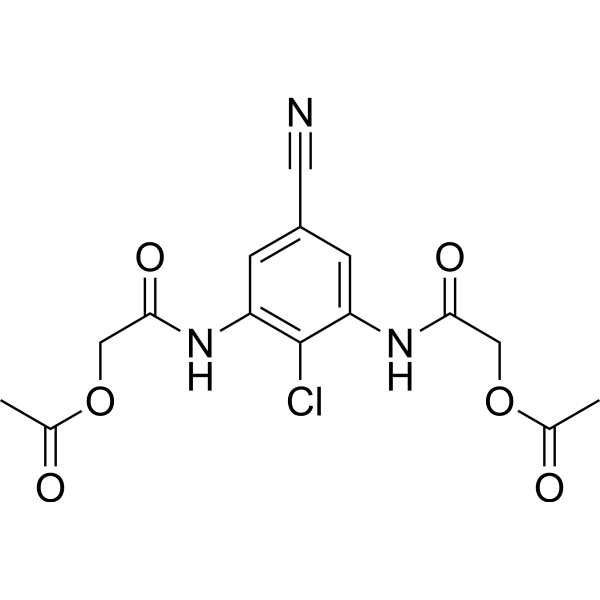 0 ImagesCat. No.: HY-14271CAS No.: 123548-56-1Synonyms: TYB-2285
-
Thiothixene
 0 ImagesThiothixene is a typical antipsychotic. It selectively binds to dopamine D2 over D1, D3, and D4 receptors (Kis=0.417, 338, 186.2, and 363.1 nM, respectively). Thiothixene also binds to various serotonin (5-HT), histamine H1, α1- and α2-adrenergic, muscarinic acetylcholine, and sigma receptors (Kis=15-5,754 nM) as well as the dopamine, norepinephrine, and serotonin transporters (Kis=3.16-30 μM). In vivo, thiothixene reduces spontaneous and amphetamine-induced locomotor activity in rats. It enhances latent inhibition, as measured by a decreased lick latency in response to light and foot shock stimuli, which is a measure of selective attention in rats.3 Thiothixene also increases competitive behavior in submissive mice, indicating antidepressant-like behavior.
-
Onitin
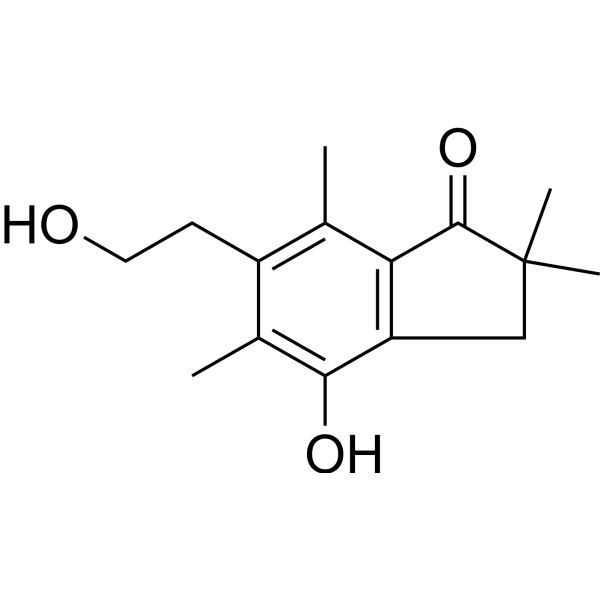 0 ImagesCat. No.: HY-N3136CAS No.: 53823-02-2Onitin is a natural product, that can be isolated from Onychium siliculosum. Onitin is also a non-competitive antagonist of histamine. Onitin shows activity in blocking the peristaltic reflex of the guinea-pig ileum, in inhibition of the responses of guinea-pig ileum to histamine and of inhibition of the responses of guinea-pig tracheal muscle to histamine.
-
Cimetidine sulfoxide (Standard)
 0 ImagesCat. No.: HY-136338RCAS No.: 54237-72-8Synonyms: Cimetidine sulphoxide (Standard)Cimetidine sulfoxide (Standard) is the analytical standard of Cimetidine sulfoxide. This product is intended for research and analytical applications. Cimetidine sulfoxide (Cimetidine sulphoxide) is a sulfoxide metabolite of Cimetidine. Cimetidine is a histamine H2-receptor antagonist. Cimetidine has the potential for peptic ulcer disease and upper gastrointestinal haemorrhage treatment.
-
Oxomemazine hydrochloride
 0 ImagesOxomemazine hydrochloride is a phenothiazine-based histamine H1-receptor blocker with pronounced antimuscarinic properties. Oxomemazine hydrochloride is a selective antagonist for muscarinic M1 receptor, displays about 20-fold difference in the affinity for high (Ki= 84 nM, M1 receptor) and low (Ki= 1.65 μM, M2 receptor) affinity sites[1]. Oxomemazine hydrochloride an antihistamine and anticholinergic agent used for the study of cough treatment.
-
Conessine dihydrobromide
 0 ImagesCat. No.: HY-107566ACAS No.: 5913-82-6Conessine dihydrobromide is an orally active and BBB-penetrable selective histamine H3 receptor antagonist. The pKi values of Conessine dihydrobromide for rat and human H3 receptors are 7.61 and 8.27, respectively. Conessine dihydrobromide is an inhibitor of the multidrug efflux pump system in Pseudomonas aeruginosa and can enhance the activity of antibiotics. Conessine dihydrobromide has antimalarial activity. Conessine dihydrobromide can also be used in the research of muscle atrophy.
-
GSK189254A (Standard)
 0 ImagesSynonyms: GSK189254 free base (Standard)GSK189254A (Standard) is the analytical standard of GSK189254A. This product is intended for research and analytical applications. GSK189254A (GSK189254 free base) is a novel, potent and selective histamine H3 receptor antagonist with pKi values of 9.59-9.90 and 8.51-9.17 for human and rat H3, respectively.




